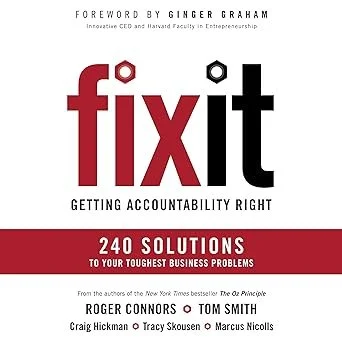
Fix It: Getting Accountability Right
Fix It: Getting Accountability Right is a practical leadership guide by Roger Connors and Tom Smith that addresses one of the most common and costly challenges in organizations: knowing how to respond when results fall short. Rather than avoiding problems or overreacting with blame, the book shows leaders how to correct performance issues in ways that strengthen accountability, ownership, and trust.
The central premise of Fix It is that most performance breakdowns are not caused by a lack of effort or intent, but by unclear expectations, misaligned systems, or ineffective responses from leaders. The book introduces a disciplined, repeatable approach for diagnosing performance gaps and choosing the right response—one that fixes the issue without damaging relationships or morale.
At the heart of the book is the Fix It Framework, which helps leaders determine why a problem occurred and what action will most effectively resolve it. Leaders learn how to distinguish between capability issues, clarity gaps, motivation challenges, and system failures, and how to respond appropriately to each. This ensures that accountability is applied fairly, consistently, and constructively.
The book emphasizes that accountability is not about punishment—it is about learning and improvement. When leaders respond correctly to problems, they reinforce ownership, encourage growth, and prevent recurring failures. Fix It also highlights the importance of holding leaders accountable for creating the conditions that enable success in the first place.
Clear, direct, and highly practical, Fix It equips managers and leaders with the tools to address issues quickly, confidently, and effectively. Its enduring value lies in helping organizations replace guesswork and frustration with clarity, consistency, and results.
Table of Contents
Part 1: See It
The Fix It Assessment
Part 2: Know It
Trait 1: Obtaining the Perspective of Others
Trait 2: Communicating Openly and Candidly
Trait 3: Asking For and Offering Feedback
Trait 4: Hearing and Saying the Hard Things to See Reality
Trait 5: Being Personally Invested
Trait 6: Learning from Both Successes and Failures
Trait 7: Ensuring My Work Is Aligned with Key Results
Trait 8: Acting on the Feedback I (We) Receive
Trait 9: Constantly Asking “ What Else Can I (We) Do?”
Trait 10: Collaborating Across Functional Boundaries
Trait 11: Creatively Dealing with Obstacles
Trait 12: Taking the Necessary Risks
Trait: 13: Doing the Things I (We) Say I (We) Will Do
Trait 14: Staying “Above The Line” by Not Blaming Others
Trait 15: Tracking Progress with Proactive and Transparent Reporting
Trait 16: Building an Environment of Trust
Part 3: Fix It
Trait 1: Obtaining the Perspective of Others
Trait 2: Communicating Openly and Candidly
Trait 3: Asking For and Offering Feedback
Trait 4: Hearing and Saying the Hard Things to See Reality
Trait 5: Being Personally Invested
Trait 6: Learning from Both Successes and Failures
Trait 7: Ensuring My Work Is Aligned with Key Results
Trait 8: Acting on the Feedback I (We) Receive
Trait 9: Constantly Asking “ What Else Can I (We) Do?”
Trait 10: Collaborating Across Functional Boundaries
Trait 11: Creatively Dealing with Obstacles
Trait 12: Taking the Necessary Risks
Trait: 13: Doing the Things I (We) Say I (We) Will Do
Trait 14: Staying “Above The Line” by Not Blaming Others
Trait 15: Tracking Progress with Proactive and Transparent Reporting
Trait 16: Building an Environment of Trust